Self-Sufficient.co.uk
Find out more about Self Sufficiency
Site Search
Main Menu
Top Products
Fruit TreesPolytunnel
Water Butts
Strimmer
Shed
Greenhouse
Porous Pipe
Latest Articles
Allotment Gardening
Grow all you can eat on your own allotment.
grow your own
20:32, 10th May 2014
Smallholding for Sale in North Devon
Three bedroom detached house in 18 acres for sale - North Devon, UK
smallholding
20:48, 17th Mar 2013
Nettles
Find out more about nettles - how to benefit from them and how to get rid of them
foraging
16:12, 13th Apr 2012
Making Nettle Beer
Find out how to make your nettle beer
recipes
16:10, 13th Apr 2012
How to Make Sloe Gin
Find out how to make your own sloe gin
recipes
14:40, 13th Apr 2012
Grow Your Own Chilli Peppers
Find out how to grow your own chilli peppers
grow your own
13:33, 16th Mar 2012
Home Beekeeping
Find out more about keeping bees in your garden for honey
grow your own
15:40, 4th Jan 2012
Storing Apples
Find out how to store apples
fruits
13:23, 28th Jul 2011
Make Your Own DIY Polytunnel
Find out how to make your own robust polytunnel for half the price of the retail product
Make Your Own DIY Polytunnel
building | grow your own | greenhouseIn our article Why Buy a Polytunnel we looked at the many benefits of polytunnels - primarily cost savings over greenhouses for an extended growing season.
Although polytunnels are considerably cheaper than greenhouses for an equivalent growing area, they are still quite expensive. In this article we will show you how you can build your own polytunnel with easy to source and cheaply available parts.
Build Your Own Polytunnel
The two main components of a polytunnel are the tunnel framework and the polythene cover. Our shopping guide to polytunnels has useful links to help you source a suitable long-lasting cover. That just leaves the framework to be put together as the DIY project.A standard polytunnel has a framework constructed from hoops of aluminimum (or other metal) tubing. This is replicated using offcuts of scaffolding tubes and mains water pipe. Both of these materials can often be sourced free of charge from building sites, or can be purchased new inexpensively.
Standard scaffolding poles (48mm outside diameter) should be cut to approximately six foot lengths. These must then be driven into the ground to approximately three foot depth sticking straight up from the ground. This will give a polytunnel with 3 foot high straight sides. Use a heavy hammer with a block of wood on the top of the tube so that it does not get damaged. A spirit level will help to ensure the poles are completely vertical.

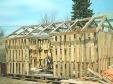
50mm inside diameter (approx 63mm outside diameter) mains water pipe (blue) must then be cut to a length such that when each end is pushed over a scaffolding pole on either side of the polytunnel it forms an apex of approximately 8 feet above the ground (as shown in the image above). Once you have got the first length correct, cut the remaining lengths to be identical.
To ensure that the water pipe does not move, drill a hole all the way through the pipe and scaffolding tube and secure using a nut and bolt. Alternatively put a large nail all the way through the hole, cut off all but the last inch or so, and then bend the remainder around towards the inside of the polytunnel (so it does not catch on the cover).
Since the polytunnel cover will not come into contact with any metal, it is not necessary to use polytunnel hot spot tape which saves yet more money.
These hoops should positioned at 4-5 feet intervals along the length of the proposed polytunnel and wooden battens used along the apex and along the each side of the polytunnel to hold everything securely.
Constructing the ends of the polytunnel with doors and vents etc is a bit more complicated, so I recommend you click here to view this detailed article which includes many photographs.
Shopping List
Here are some useful links to relevant products:
Article Published: 17:12, 17th Sep 2008
Related Articles
Why Buy a Polytunnel
Learn about Polytunnels and their benefits
Article Published: 17:12, 17th Sep 2008
building | grow your own | greenhouse | smallholding
Polytunnel Hot Spot Tape
Find out about the use of anti hot spot tape in polytunnels
Article Published: 12:29, 9th Jul 2008
building | grow your own | greenhouse
Greenhouse from Plastic Bottles
Build a greenhouse from old plastic bottles
Article Published: 10:19, 3rd Jun 2010
greenhouse | building | grow your own
The Greenhouse
Find out more about the benefits of greenhouses and glasshouses
Article Published: 12:29, 9th Jul 2008
greenhouse | building | grow your own | smallholding
Choosing a Greenhouse
Decide which greenhouse is right for you
Article Published: 12:37, 20th Apr 2011
greenhouse | building | grow your own
Greenhouse Thermometer
Use a suitable max min thermometer to track temperatures in a greenhouse
Article Published: 10:23, 13th Jan 2011
greenhouse | building | grow your own
Watering Your Greenhouse
Find out how to keep your greenhouse plants well watered
Article Published: 12:29, 9th Jul 2008
greenhouse | grow your own
Greenhouse Ventilation
Understand the importance of venilation in a greenhouse
Article Published: 12:29, 9th Jul 2008
greenhouse | grow your own
Smallholding for Sale in North Devon
Three bedroom detached house in 18 acres for sale - North Devon, UK
Article Published: 20:48, 17th Mar 2013
smallholding | building | grow your own
Wireless Thermometer
Use a wireless thermometer to track the temperature in your greenhouse
Article Published: 11:26, 10th Jan 2011
grow your own | greenhouse